

T-slot cast iron platform: for assembly, inspection and layout work
Oct 27,2026
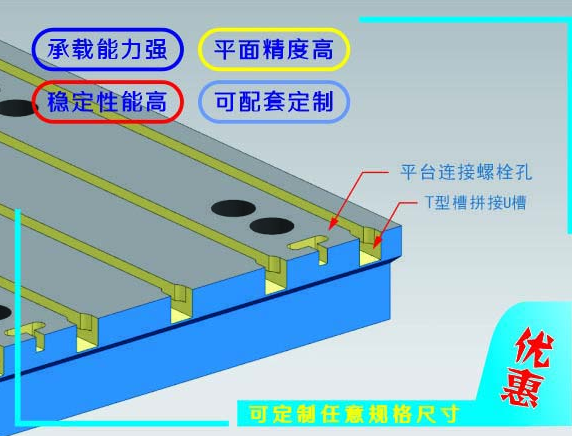
A T-slot cast iron platform is a cast iron surface plate whose working face is machined with parallel T-slots. Those slots turn a flat datum into a bench where a workpiece can be clamped, measured, marked off and assembled without being moved between operations. This guide covers what the slots fit, the material and grades, the size range, and the installation points that decide whether the platform still measures flat in service.
What the T-slots actually do
A T-slot is a fastening system built into the working face. A bolt head or T-nut drops into the slot, turns through 90 degrees and locks at any position along its length. Clamps, stops, angle brackets, jigs and fixtures can therefore be fixed, repositioned and released in seconds.
For a workshop that runs mixed work, this matters in three ways:
- One platform, many workpiece sizes. A small casting and a large weldment can both be clamped on the same face, because the clamping position is not fixed by pre-drilled holes.
- Fixtures are reused, not remade. Standard clamps and supports adapt to the next job, removing the tooling cost of a dedicated fixture for every part.
- Layout work becomes repeatable. Hard stops and scribing aids clamp into the slot, so marking-off is referenced to the slot, not to a loose rule.
The same face can carry other locating features. T-slots, V-grooves, U-grooves, dovetail slots, round holes and long holes can all be machined into the working surface. V-grooves locate cylindrical parts, dovetail slots take sliding fixtures, and round or long holes hold dowel pins and adjustable stops.
Material, hardness and how the casting is stabilized
| Item | Specification |
|---|---|
| Manufacturing standard | JB/T7974-1999 |
| Verification procedure | JJG117-91 |
| Material | High-strength fine-grained gray cast iron, HT200-300 |
| Working surface hardness | HB 170-240 |
| Standard structure | Rib-plate type; box type or other structures for assembly platforms |
| Accuracy grades | Grade 1, Grade 2, Grade 3, fine planed |
| Working surface finish | Hand scraping |
The platform is cast as one piece of high-strength gray iron. The body then goes through two rounds of aging and stress relief, an initial tempering stage followed by a second aging treatment after rough machining, before the working face is finish scraped by hand. Residual stress that is not released during manufacture comes out later as distortion of the working face, which is the difference between a platform that holds its grade for a decade and one that needs re-machining within two years.
Sizes: standard range, custom work and spliced large beds
Standard platforms run from 100 x 100 mm up to 4000 x 8000 mm. Beyond that, two options exist:
- Non-standard sizes are produced to drawing. Send the length, width, thickness, required grade and the slot layout.
- Above 4000 x 8000 mm, the platform is built as spliced sections rather than as a single casting. Splicing keeps the casting sound and keeps transport practical. Large test and assembly benches are built this way, and we produce them up to around 15 m.
Choosing the accuracy grade
| Grade | Working surface | Typical duty |
|---|---|---|
| Grade 1 | Hand scraped | Metrology room, precision inspection, dimensional and form-tolerance checking of tight parts |
| Grade 2 | Hand scraped | General workshop inspection, layout and marking-off |
| Grade 3 | Hand scraped | Assembly, fitting, lapping and support work where the face is a working surface |
| Fine planed | Machine planed, not scraped | Support and rough marking where a scraped finish is not required |
Grade selection should follow the job: a datum that other measurements are traced back to needs a scraped grade 1 or 2 face, while assembly, clamping and support work is served by grade 3 scraped or fine planed, at lower cost and shorter lead time.
Setting the platform up so it stays flat
Installation is where a good platform is most often compromised.
- Place three adjustable leveling wedges under three support points of the underside.
- Put a precision frame level on the working face and read the error in the longitudinal, transverse and diagonal directions.
- Where a reading is out of tolerance, turn the corresponding wedge slightly to raise or lower that point.
- Re-measure and repeat until every measuring position is within the grade tolerance.
- Tighten the locking nuts on the wedges so that nothing shifts in service.
Two details are easy to miss. Platforms longer than 2 m need auxiliary support points as well as the three main supports, and these must only just touch the underside; if they carry load and jack the platform up, they distort the flatness they were meant to protect. Second, re-level a newly installed or relocated platform once a week for the first month, then return to the normal calibration interval.
Where T-slot platforms are used, and what to send us
T-slot platforms are standard equipment in machine tool building, automotive and motor manufacturing, shipbuilding, mold making, equipment installation and commissioning, and instrument calibration. Typical jobs are inspection against a datum, marking-off, fitter assembly and lapping, and test or assembly benches.
To quote a platform, send us:
- Overall dimensions, length x width x thickness
- Required accuracy grade, and whether the face should be scraped or fine planed
- Slot layout, including T-slot size and pitch plus any V-groove, dovetail or hole pattern
- Working duty: inspection datum, assembly bench, test bed or welding support
- Static load and workpiece weight, if the platform will carry assembled machinery
Frequently asked questions
How many T-slots should a platform have? It depends on the workpiece sizes you clamp and the clamp positions you need, not on platform size. Most customers specify a slot pitch that lets a standard clamp reach the middle of both the smallest and the largest part they run. Send us those two extremes and we will propose a layout.
Can a T-slot platform also be used as a measuring datum? Yes. A grade 1 or grade 2 T-slot platform with a scraped face measures as a surface plate does. Using it additionally as a clamping bench is acceptable if it is protected from impact and from heavy point loads.
Does machining the slots weaken the platform? The slots are part of the casting design, and standard slot layouts are accounted for in the wall and rib thickness. If you need unusually deep slots or a very dense layout, tell us at enquiry stage so that the casting can be designed for it.
How long does a T-slot cast iron platform hold its accuracy? On a properly tempered and aged casting, with correct three-point support and normal workshop conditions, more than a decade of service is realistic. Failures are nearly always caused by insufficient stress relief or by incorrect support, not by wear.
Can you produce a platform larger than the standard range? Yes. Non-standard sizes are made to drawing, and platforms above 4000 x 8000 mm are produced as spliced sections. Test and assembly benches up to around 15 m are available.
Need a T-slot cast iron platform quoted to your drawing?
Hebei Yuanpeng Machine Tool and Measuring Implement Co., Ltd. has manufactured cast iron platforms and measuring tools since 1995. We hold the national plate measuring tool production license and were among the first in the industry to obtain ISO 9001 certification. Our platforms are exported to the United States, Europe, Japan, South Korea and other markets.
Send your drawing, required grade, slot layout and quantity to yuanpeng@yepoweldingtables.com, or use the enquiry form on our contact page. We reply within one working day.
Related products: Double-direction T-slot cast iron plate · Cast iron platform series · High precision flat cast iron plate · Cast iron surface plate: grades, standard and verification
Previous Page:

Contact Us
E-mail:
yuanpeng@yepoweldingtables.com
Service Hotline:
+86-19933786909
Address:
Industrial Development Zone, Jiaohe Town, Botou City

Sales Hotline: +86-19933786909
E-Mail: yuanpeng@yepoweldingtables.com
Address: (Hebei Province, China) Jianshe Road, Jiaohe Town, Botou City, Cangzhou City, Hebei Province


INQUIRY