

Welding table legs: fixed, threaded adjustable or hydraulic
Oct 21,2026
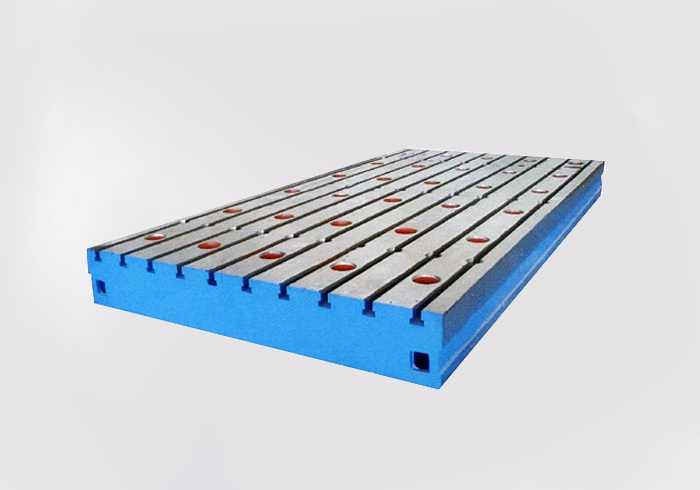
Buyers spend weeks choosing a welding table and ten minutes choosing its legs. Then the legs decide whether the table stays flat, whether the operator can reach the work, and how long the setup takes to change.
Legs are usually sold as an accessory, but industry practice sorts them by structure and load behaviour, because the three families solve different problems.
What the legs actually carry
A welding table is a frame with a flat top. The top holds the workpiece; the legs hold everything else: the weight, the reaction forces of clamping, and the load path into the floor.
Two consequences follow. First, an uneven floor will twist a rigid frame unless the legs can be adjusted. Second, a heavy workpiece raises the reaction loads, so the leg must be rated for them rather than chosen by height alone. Getting this wrong shows up later as a table that is flat on the day of installation and not flat three months afterwards.
Fixed-height legs
Fixed legs are the simplest of the three: a welded or cast structure with no adjustment.
- Structure is simple and cost is the lowest of the three families.
- Support rigidity is high, because there is no adjustment thread or cylinder in the load path.
- They suit production lines where the cell layout is fixed and the workpiece weight stays constant.
- They are the right answer when nobody needs to change table height or re-level the top.
If your shop floor is level and the workstation never moves, fixed legs are the cheapest way to get a stable table. The limitation is obvious: correcting a floor that settles, or raising the table for a taller operator, means lifting the table and shimming it.
Manual threaded adjustable legs
Threaded legs adjust height by rotating a screw thread, which is what makes them the practical choice for real shop floors.
- Height is corrected by turning the thread, so the top can be brought back to level without lifting the table.
- They suit floors that are not flat, and cells that are rearranged from time to time.
- They are the most widely used type in small and mid-size fabrication shops.
- Adjustment is manual, so levelling is a job someone has to do rather than a button.
This is the type most buyers should start from. It costs a little more than fixed legs and covers the two things that actually go wrong in service: floors that are not level, and layouts that change.
Hydraulic lifting legs
Hydraulic legs are built for heavy work and for ergonomics.
- They are aimed at large, heavy weldments that are awkward to load at a fixed height.
- Height is changed at the touch of a control rather than by turning threads.
- They let the operator bring the work to a comfortable working height, which reduces fatigue on long shifts.
- Because they carry the highest loads of the three, they belong on tables sized for that duty.
Hydraulic legs are not simply "the best option". They add cost and a maintenance item, and they only pay back where workpieces are large or where operator height matters day after day.
Choosing by what you actually do
| Leg type | Structure | Where it fits |
|---|---|---|
| Fixed height | Simplest and cheapest, highest rigidity | Fixed cells, constant workpiece weight, production line work |
| Threaded adjustable | Screw-thread height correction | Uneven floors, cells that get rearranged, small and mid-size shops |
| Hydraulic lifting | Powered height change, built for heavy loads | Large and heavy weldments, ergonomic working height |
Two practical rules follow from this table. If the floor is level and the layout is permanent, do not pay for adjustment you will never use. If the floor is not level, do not buy fixed legs and plan to shim them later — shimming is a two-person job that nobody schedules.
Before you order
- Confirm the leg is rated for the workpiece weight you actually run, not the table's nominal size.
- Check that the feet can be fixed to the floor if the table will be pushed during clamping.
- For hydraulic legs, confirm who services the hydraulics locally.
- Ask whether the leg height range matches your operators, not just the machine.
Frequently asked questions
Do I need adjustable legs?
If the floor is level and the table never moves, no. If either is untrue, yes — threaded adjustable legs are the cheaper way to solve both.
Are hydraulic legs worth it?
Only where workpieces are large or heavy enough that loading height matters, or where operator fatigue is a real cost. For a 1 m table on a level floor they are hard to justify.
Can I retrofit legs later?
Treat the leg as part of the table purchase. A table bought with fixed legs and later re-legged usually costs more than buying the right type first.
Which type is most common in small shops?
Manual threaded adjustable. It is the compromise that handles uneven floors and occasional layout changes at modest cost.
Do legs affect the accuracy of the top?
They do not change the top's machined accuracy, but they decide whether the table sits without twist. A flat top on a twisted frame measures wrong.
Need a table and legs quoted together?
Hebei Yuanpeng Machine Tool And Measuring Implement Co., Ltd. has been making cast iron measuring and welding equipment since 1995. We hold a national production licence for plate measuring tools and were among the first in the industry to obtain ISO 9001 certification. Our products sell across all 31 provinces of China and are exported to the United States, Europe, Japan and South Korea.
Send the table size, the workpiece weight and your floor conditions to yuanpeng@yepoweldingtables.com, or use the enquiry form on our contact page, and we will quote table and legs together within one working day.
Related products: Cast iron platform series · High precision flat cast iron plate · Bidirectional T-slot cast iron plate
Previous Page:

Contact Us
E-mail:
yuanpeng@yepoweldingtables.com
Service Hotline:
+86-19933786909
Address:
Industrial Development Zone, Jiaohe Town, Botou City

Sales Hotline: +86-19933786909
E-Mail: yuanpeng@yepoweldingtables.com
Address: (Hebei Province, China) Jianshe Road, Jiaohe Town, Botou City, Cangzhou City, Hebei Province


INQUIRY