

Granite vs cast iron for precision measuring bases
Oct 20,2026
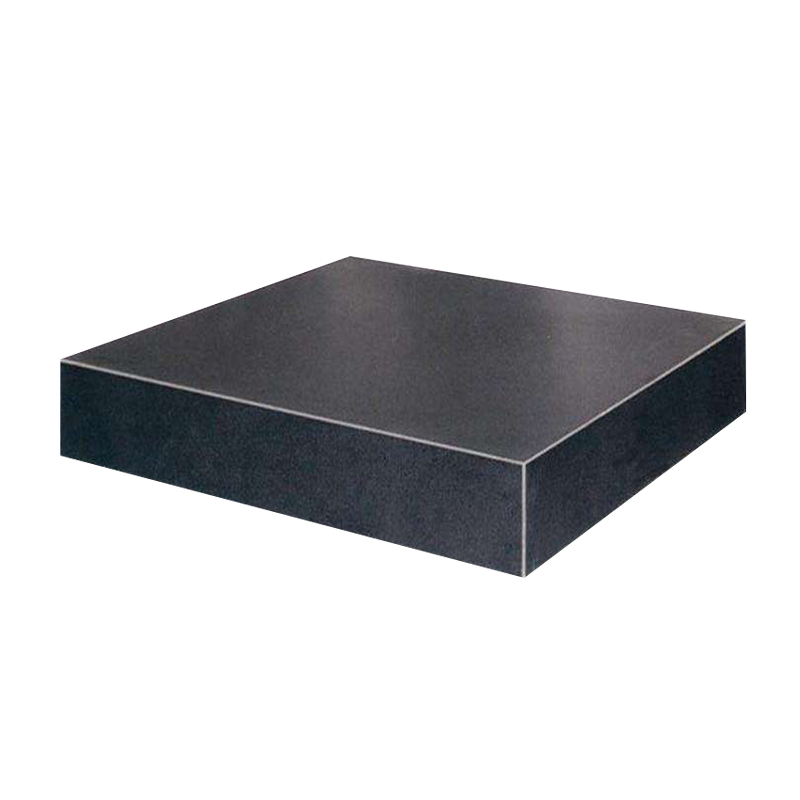
A precision measuring base has to stay flat for years, and the two materials that dominate the category, granite and cast iron, hold that flatness in different ways. The choice comes down to what the base will do: measure only, or measure and also hold, clamp and weld. This guide compares the two on accuracy, maintenance, machining and temperature.
Granite: the "Jinan Black" measuring base
Precision granite bases are made from "Jinan Black" stone: a dense, uniform black granite with good stability, high strength and high hardness, which is why it holds accuracy well. The working surface is produced by hand lapping, which reaches accuracy that machine processing cannot match.
Granite is non-metallic, so it shows no magnetic response and no plastic deformation. It does not rust, resists acid and alkali, resists wear and does not deform. If a heavy object is dropped on it, at most a few grains of stone chip off. Granite bases check the flatness and perpendicularity of parts, workpieces, machine tables and guideways.
Granite accuracy grades and what each one is for
| Grade | Flatness over 1 m | Typical use |
|---|---|---|
| 000 (ultra precision) | 0.3 µm or less | Coordinate measuring machine reference tables, lithography machine bases, aerospace inspection tooling. Needs a ±0.1 °C dust-free workshop and at least three hand fine-lapping passes |
| 00 and 0 | 1 µm to 3 µm | Metrology room inspection platforms, precision machine tool guideway references, locating bases on automated lines |
| 1 (general industrial) | Within 10 µm | Sample inspection of ordinary parts, production line fixture locating |
Grade alone is not the whole story: two bases of the same nominal grade can differ in thermal deformation coefficient and aging behavior, so ask for a full-dimension report from a CNAS-accredited body.
Cast iron: what HT200-300 offers
Cast iron bases are made from high-strength fine-grained gray iron HT200-300 with a hand scraped working surface and a hardness of HB 170-240, manufactured to JB/T7974-1999 and verified to JJG117-91. Standard sizes run from 100 x 100 mm to 4000 x 8000 mm, in grades 1, 2 and 3 plus a fine planed finish, with larger beds built as spliced sections and non-standard sizes produced to drawing. Graphite assists lubrication and oil retention, so a scraped surface wears slowly, and it gives cast iron better vibration damping than steel. The machined grooves and holes are the practical advantage: fixtures and workpieces clamp directly on the plate. For full details, see our cast iron surface plate guide.
Granite vs cast iron: side-by-side
| Point of comparison | Granite ("Jinan Black") | Cast iron (HT200-300) |
|---|---|---|
| Accuracy retention | High hardness, no plastic deformation; hand lapped surface holds accuracy well | Hand scraped and verified; depends on stress relief and heat treatment quality |
| Rust and protection | Does not rust, so no anti-rust oil is needed | Must be protected with anti-rust oil and moisture-proof paper |
| Magnetic behavior | Non-metallic, no magnetic response | Magnetic material |
| Machined slots and holes | Can be drilled and grooved to order | V, T and U grooves, dovetail slots, round and long holes as standard |
| Work holding | Clamping arranged through holes or grooves made to order | T-slots let clamps and fixtures be bolted down directly |
| Large formats | Produced to drawing | Standard range to 4000 x 8000 mm; larger beds built as spliced sections |
| Temperature sensitivity | Stable, but still sensitive to ambient temperature difference and humidity | Working temperature 20 ± 5 °C; a temperature change introduces measurement error |
| Typical use | Pure metrology reference, coordinate measuring machine base, guideway reference | Inspection, marking-off, assembly, welding support, test beds |
Temperature and environment rules that apply to both
Granite is stable, but still sensitive to ambient temperature difference and humidity. A stone base in front of an air-conditioning outlet, beside a radiator, or in a room humid enough to condense on the surface can slowly lose its accuracy. Acid and alkaline solutions and chemical reagents must never be placed on the working surface, because the damage to the stone is irreversible. Cast iron has its own limit: use it within 20 ± 5 °C, since temperature change introduces measurement error.
One rule applies to both. A workpiece from a large temperature difference must not go straight onto the base; let it stand in the same room for 2 to 3 hours to complete the isothermal match, or condensation will corrode a precision working surface.
Maintenance: where the two diverge
- Granite. No anti-rust oil. Clear chips and stains after use, cover the base when idle, and keep hard debris off the surface so it cannot score the lapped face. Oil that works into the stone is hard to remove. Do not stack heavy objects in one place or lean the base against a wall, since uneven stress can change the flatness.
- Cast iron. Wipe the surface clean after use, apply acid-free anti-rust oil, cover it with moisture-proof paper and store it in a clean, dry place. Keep it away from moisture, heat sources and corrosive gases or liquids, and inspect it periodically, at most one year apart.
Which material should you buy?
- Choose granite when the base is a pure metrology reference: it does not rust, needs almost no maintenance, has no magnetic response and keeps its accuracy over a long service life. It is also the better answer for 000 grade work, which needs a controlled workshop.
- Choose cast iron when the base has to do work as well as measure: when fixtures and workpieces must be clamped in T-slots, when the base is used for welding or assembly, when the bed is very large and built from spliced sections, or when cost per piece decides.
For measuring only, take granite; for measuring plus clamping, welding and large spliced beds, take cast iron.
Frequently asked questions
Is granite more accurate than cast iron? For a pure reference surface, yes. Hand lapped granite bases come in grades 000, 00, 0 and 1, with 000 grade held to 0.3 µm or less over 1 m. Cast iron plates cover grades 1, 2 and 3 plus a fine planed finish, for workshop inspection and assembly work.
Can a granite base be drilled and grooved like a T-slot cast iron plate? Yes. High-precision granite surfaces can be drilled and grooved to customer requirements. Cast iron still offers the wider range of standard machining options.
Does a granite base need anti-rust oil? No. Granite does not rust, so no anti-rust oil is applied. It needs a dust cover when idle and protection from hard debris that could score the surface.
How long should a workpiece stand on the base before measurement? If it comes from a large temperature difference, let it stand in the same room for 2 to 3 hours to complete the isothermal match. That avoids condensation on the working surface and an extra measurement error.
Why is cast iron still used for measuring bases when granite holds accuracy better? Because the base usually has to do more than measure. Cast iron takes T-slots and other machined features so fixtures can be fastened directly, it can be produced as large spliced beds, and its graphite gives it good wear resistance and vibration damping.
Need a granite or cast iron base quoted to your drawing?
Hebei Yuanpeng Machine Tool and Measuring Implement Co., Ltd. has manufactured measuring tools, cast iron bases and granite components since 1995. We hold the national plate measuring tool production license and were among the first in the industry to obtain ISO 9001 certification. Our products are exported to the United States, Europe, Japan, South Korea and other markets.
Send the material you prefer, the dimensions, the accuracy grade and the groove or hole layout to yuanpeng@yepoweldingtables.com, or use the enquiry form on our contact page. We reply within one working day.
Related products: Granite components · Granite series · Granite component detail · Cast iron platform series
Previous Page:

Contact Us
E-mail:
yuanpeng@yepoweldingtables.com
Service Hotline:
+86-19933786909
Address:
Industrial Development Zone, Jiaohe Town, Botou City

Sales Hotline: +86-19933786909
E-Mail: yuanpeng@yepoweldingtables.com
Address: (Hebei Province, China) Jianshe Road, Jiaohe Town, Botou City, Cangzhou City, Hebei Province


INQUIRY